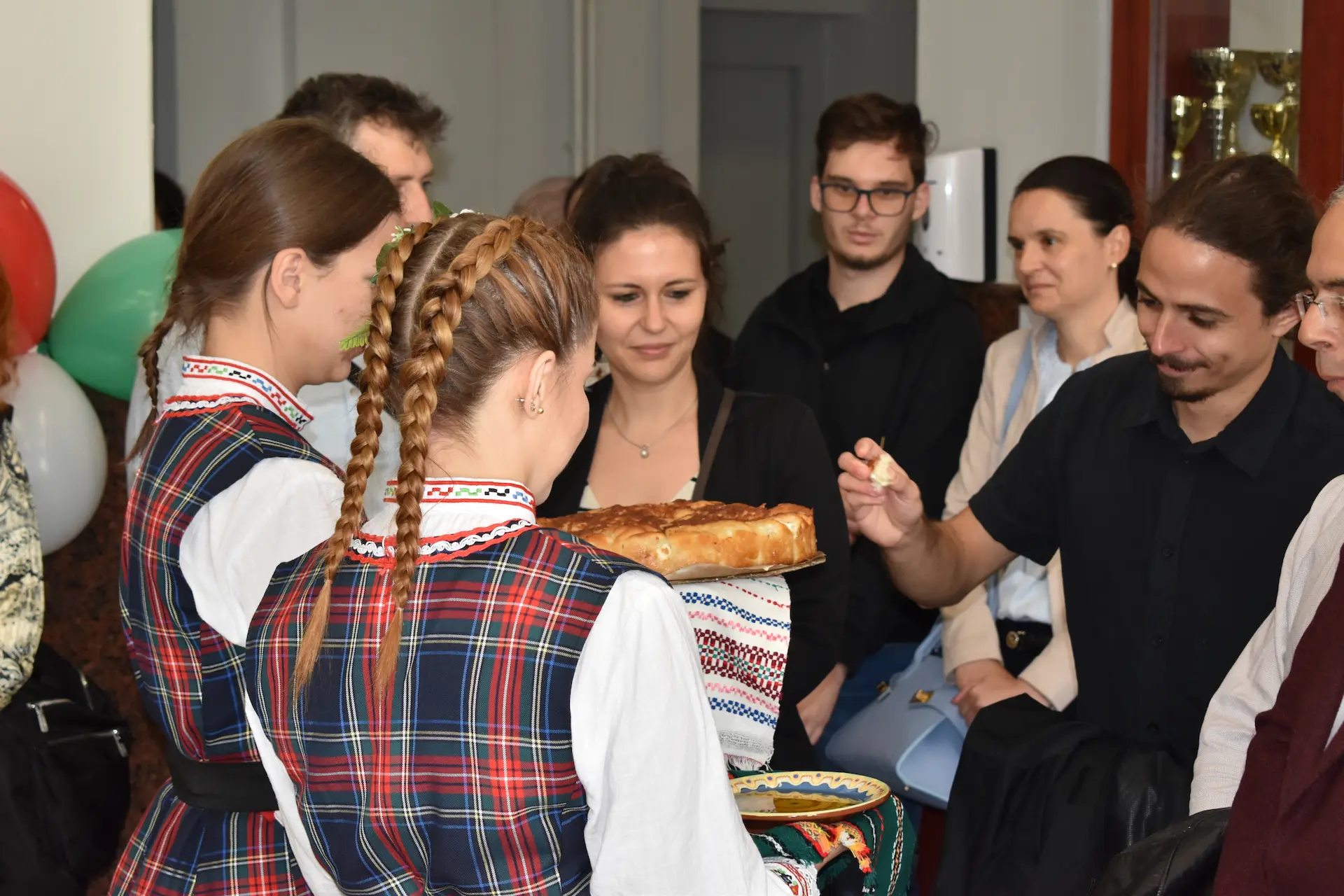
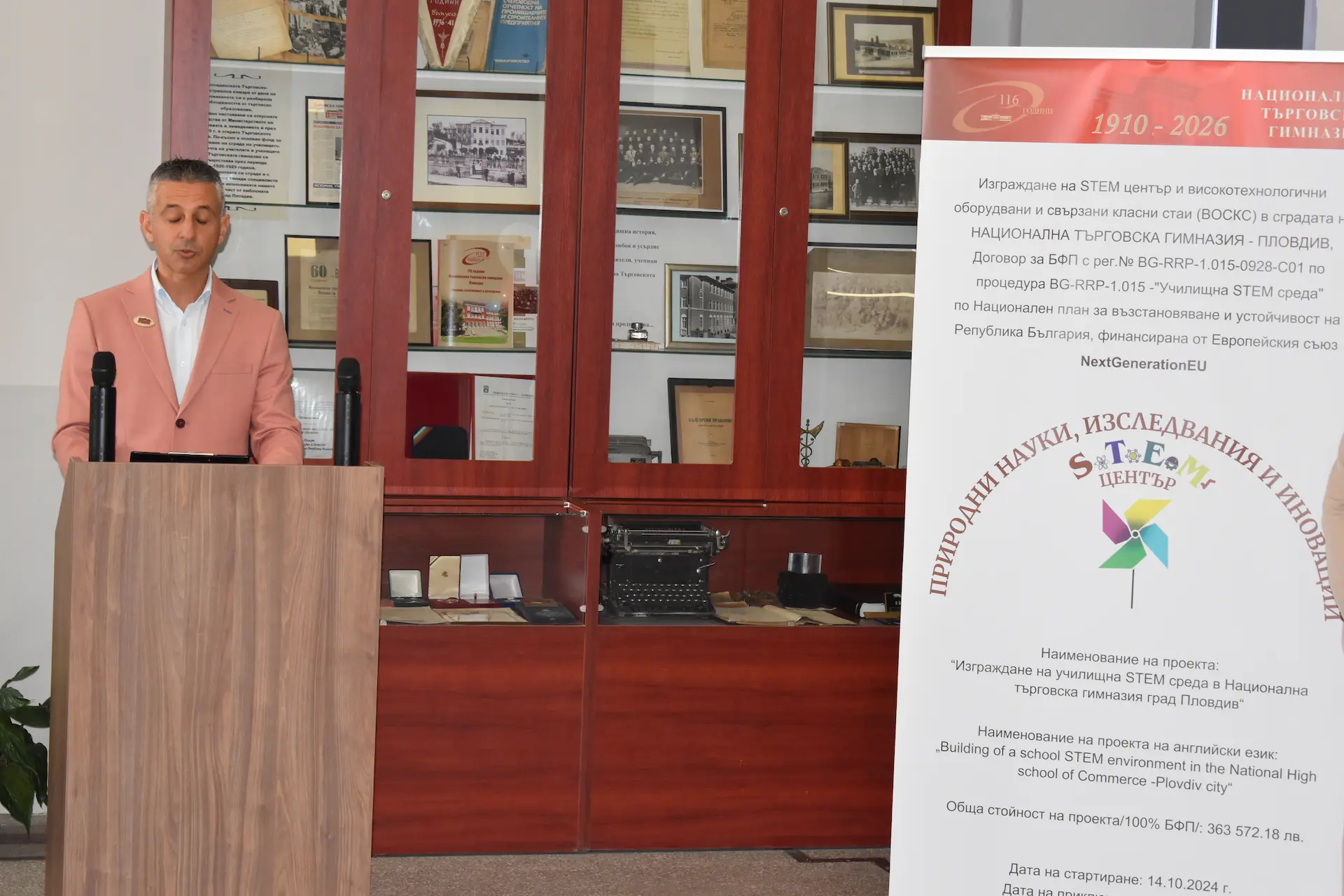
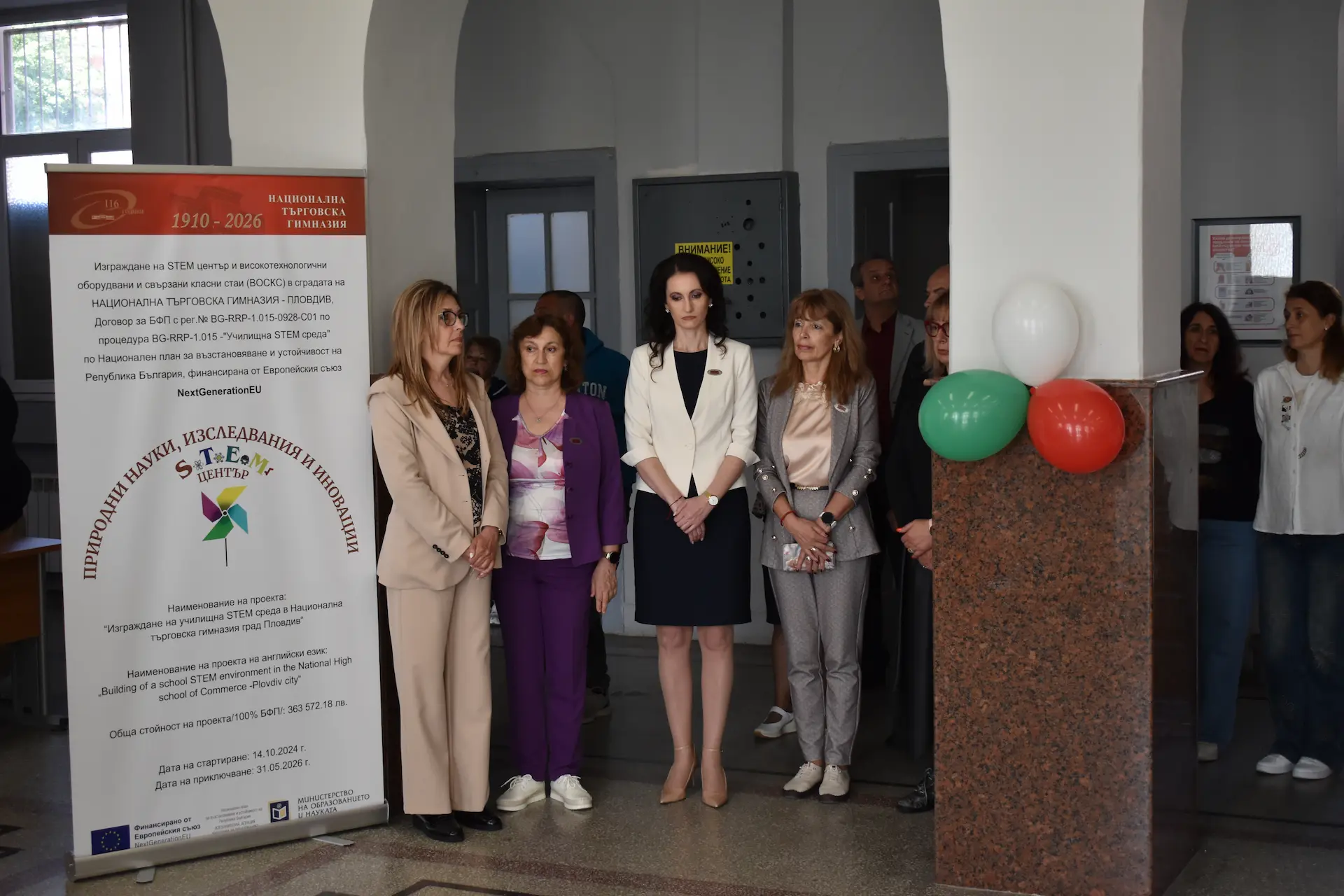
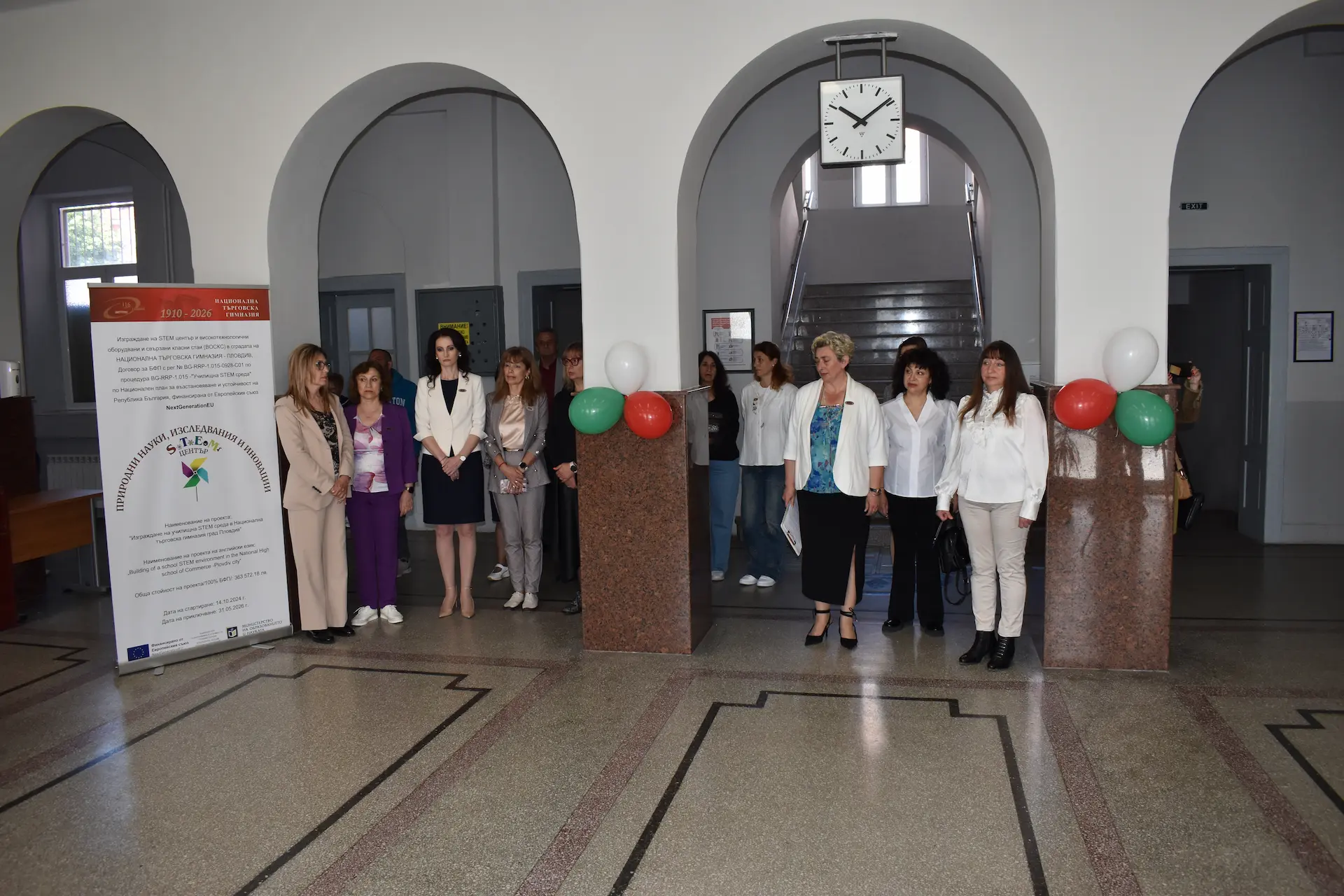
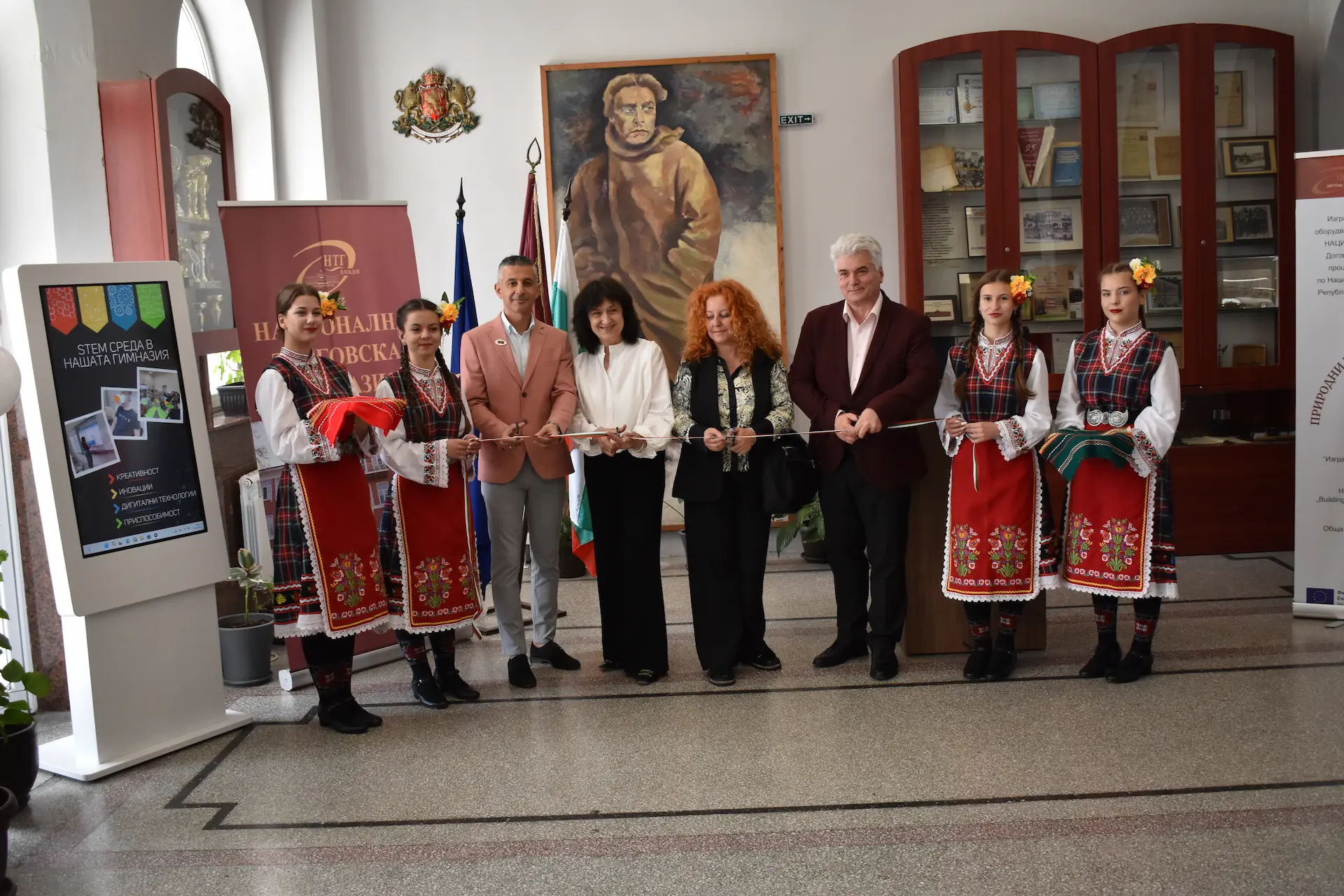
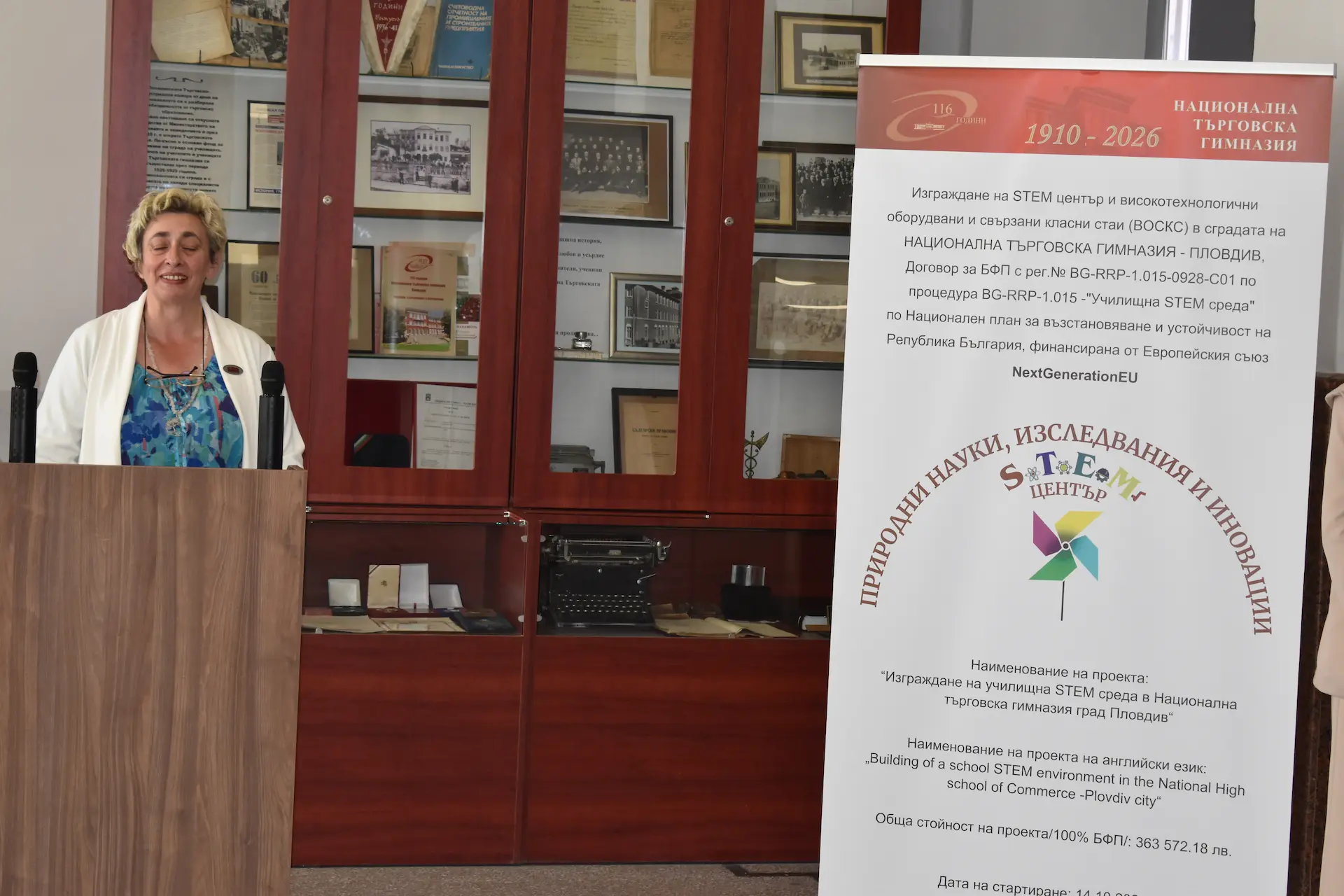
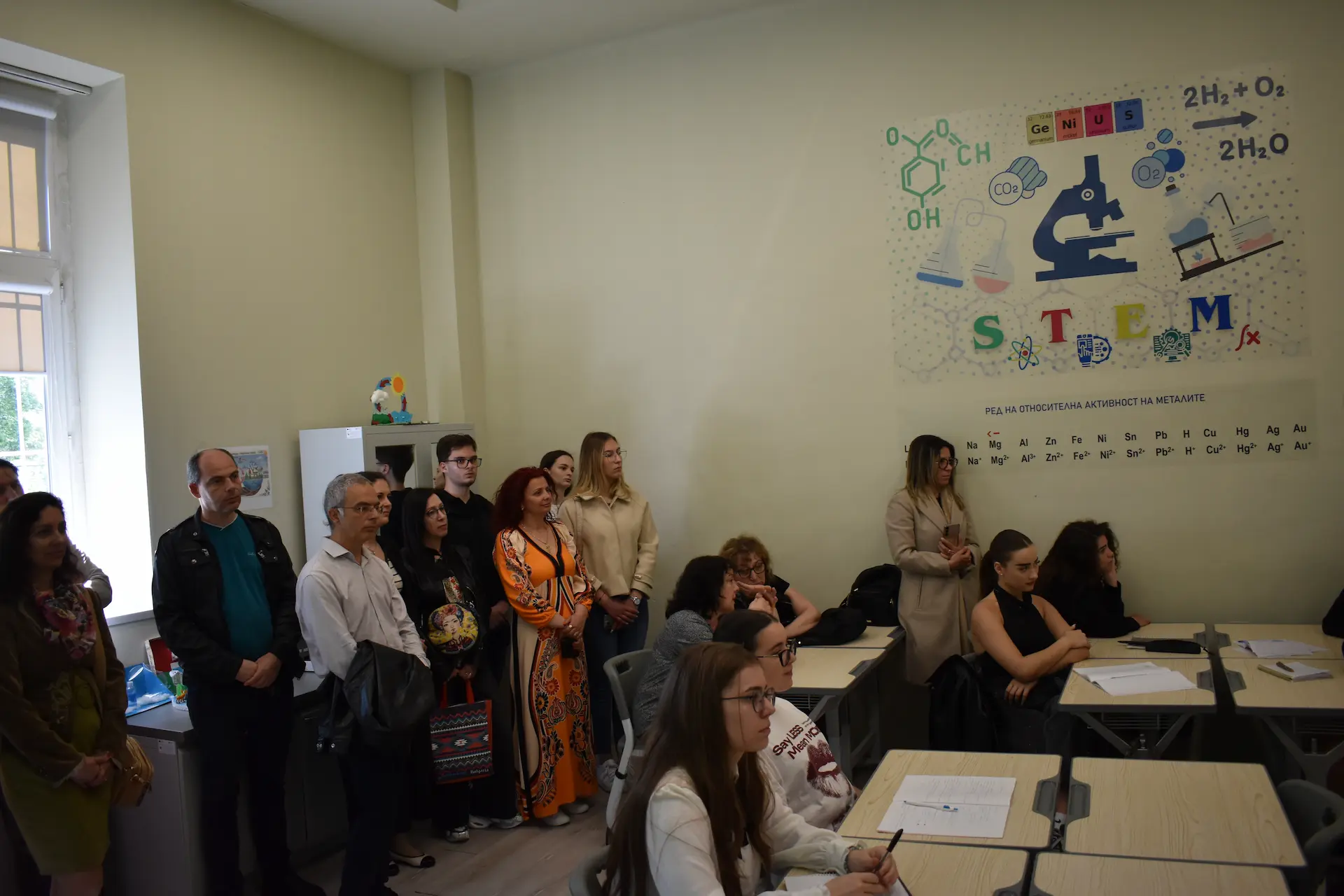
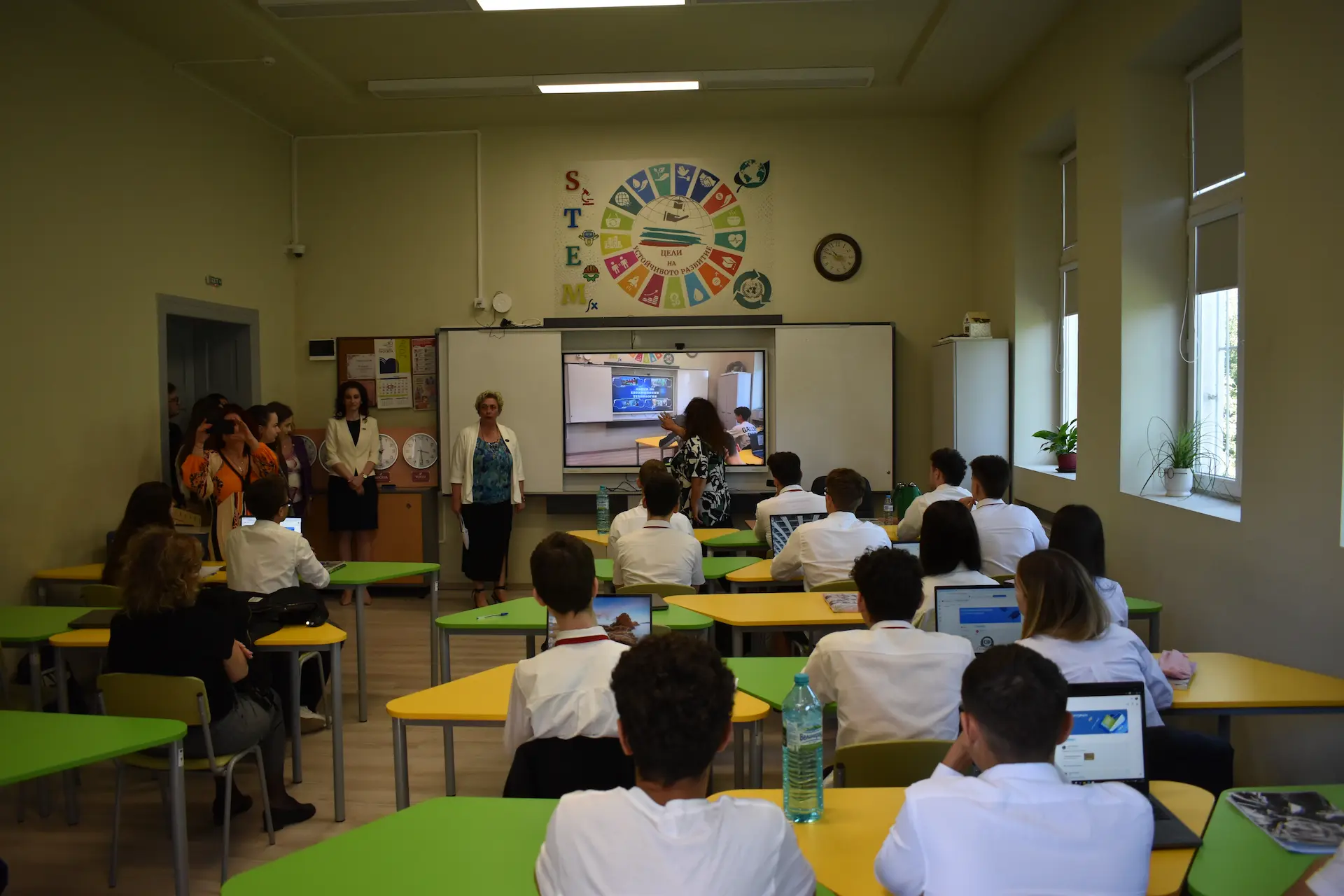
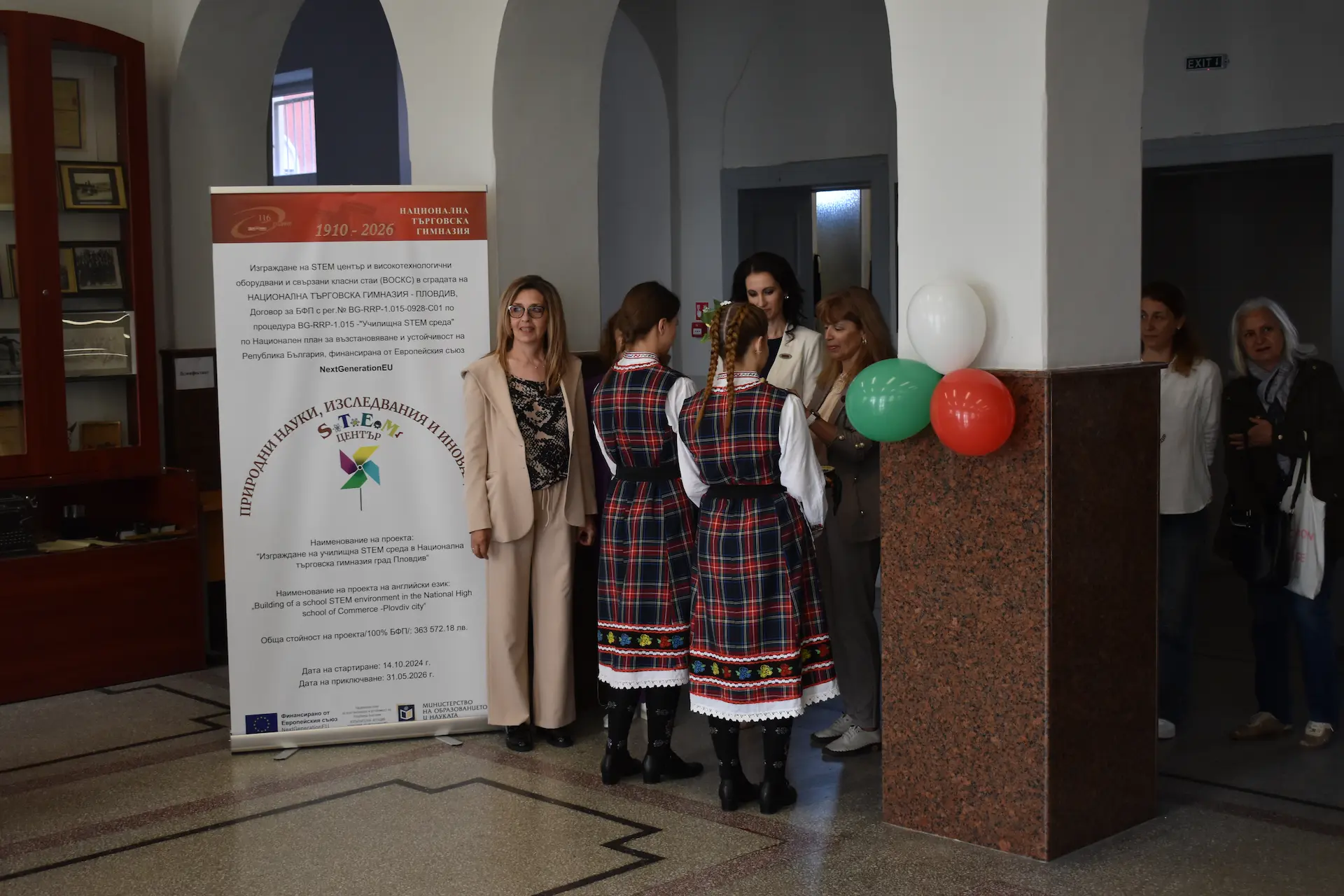
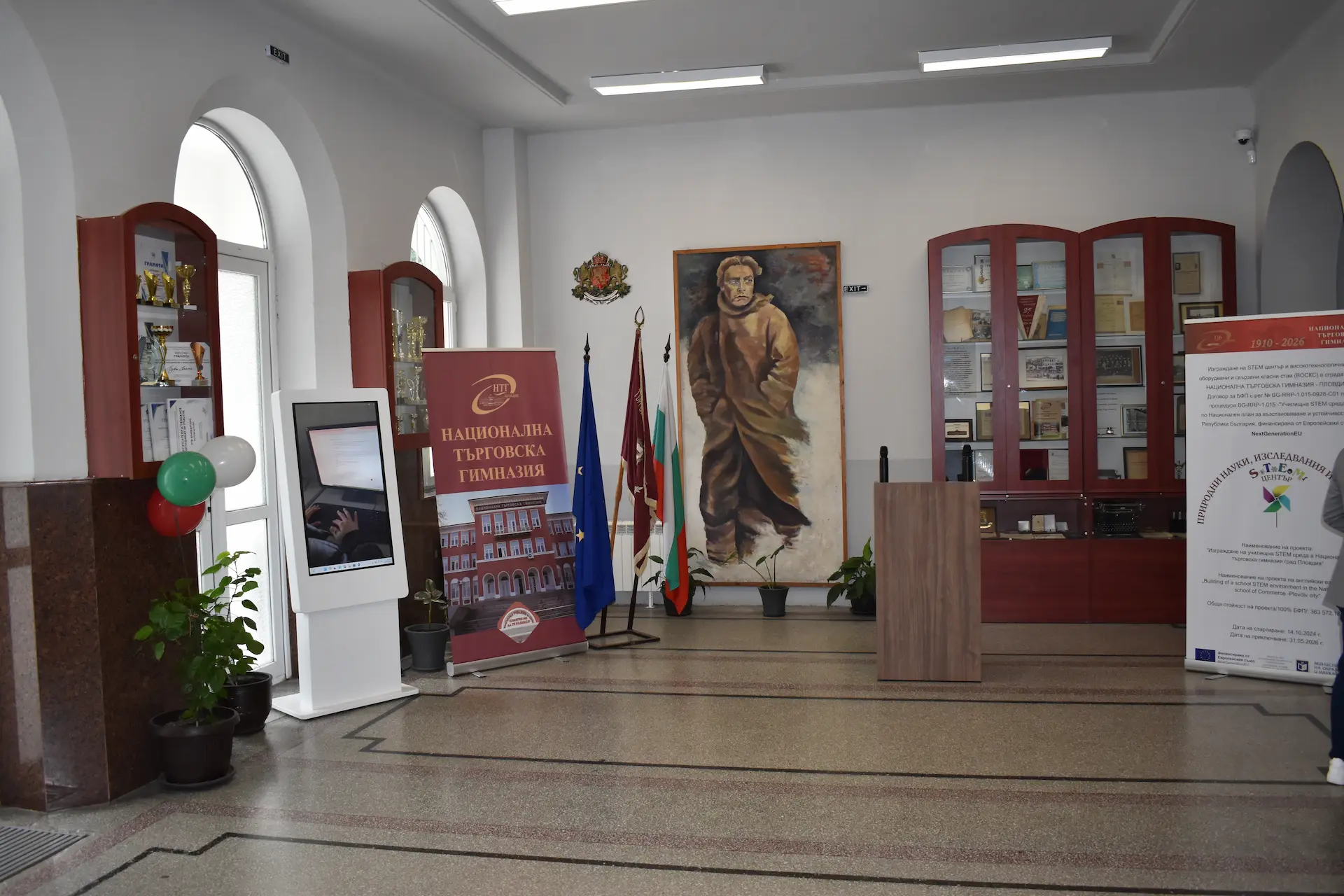
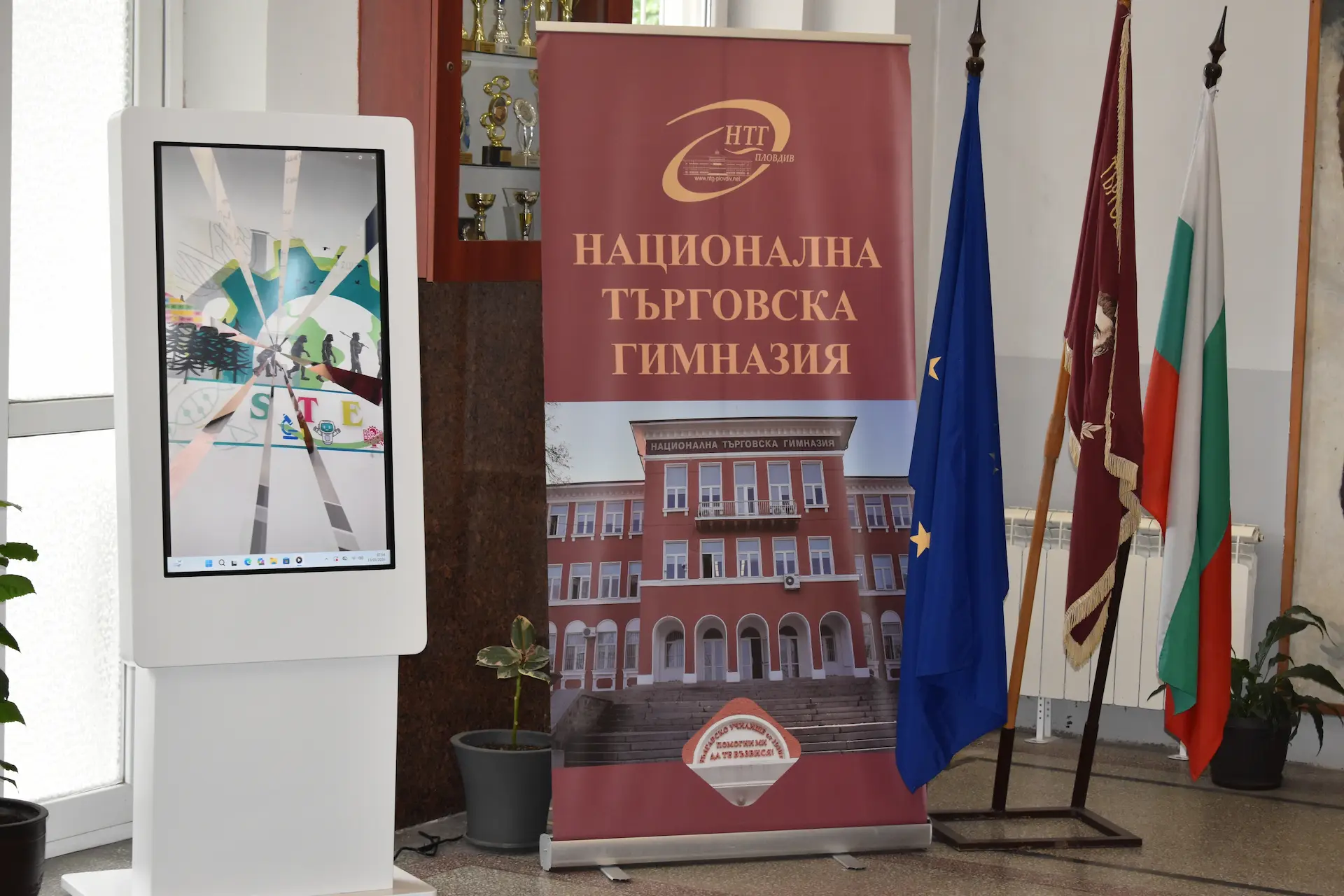
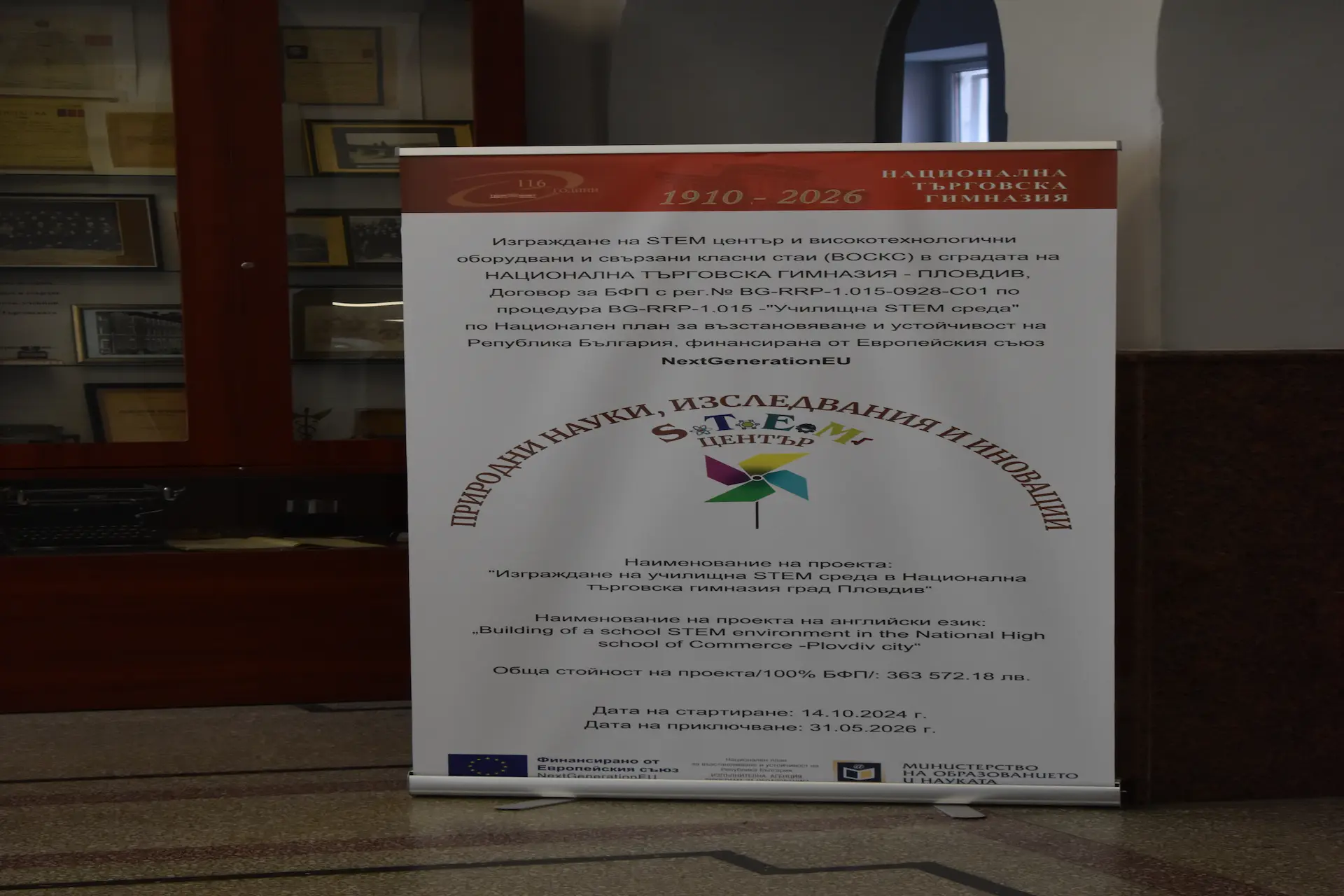
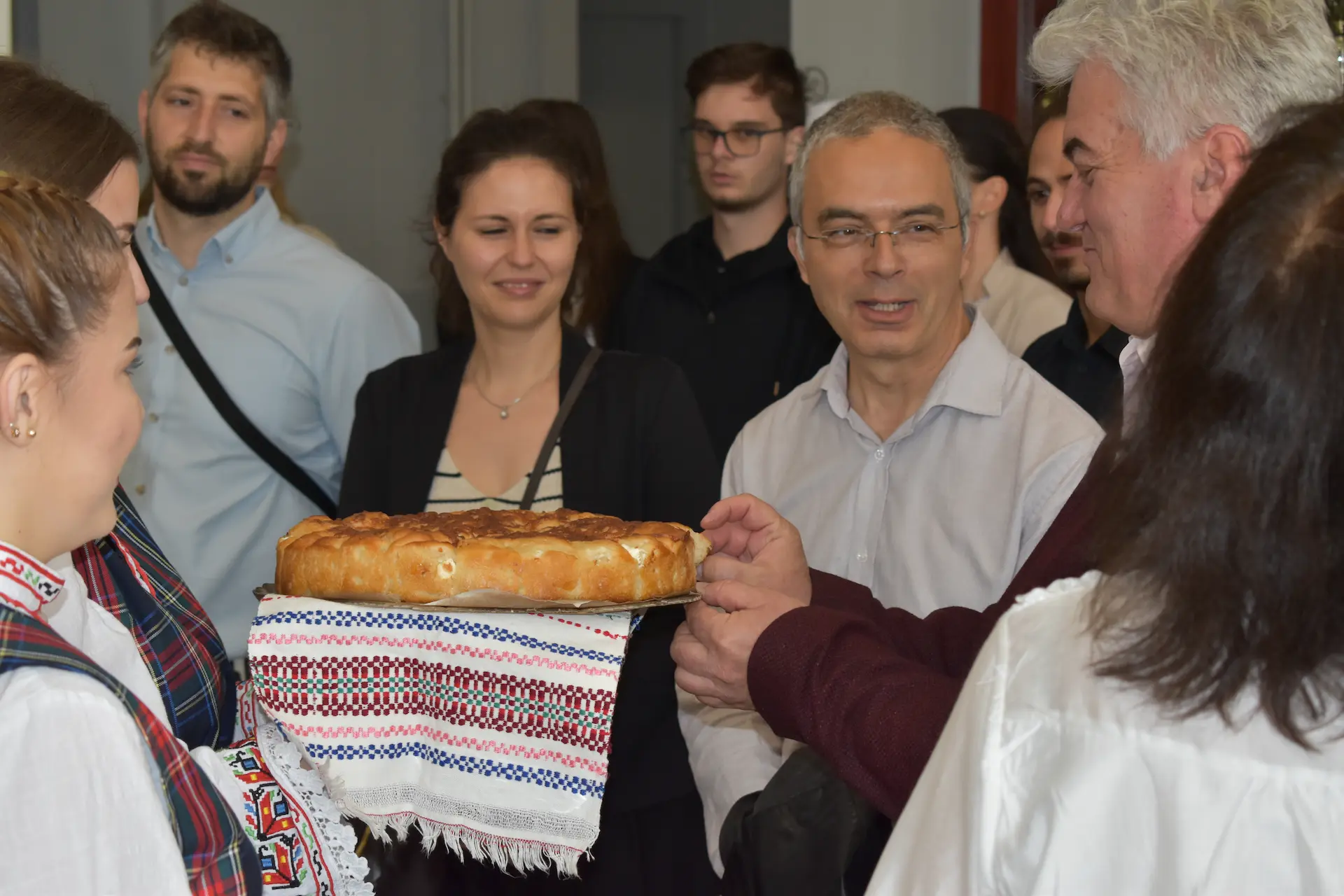
In front of students – in the role of researchers, teachers – in the role of mentors, and official guests – in the role of potential investors and entrepreneurs, the new modern STEM Center for NATURAL SCIENCES, RESEARCH AND INNOVATION was officially opened. The event was not just a traditional ribbon-cutting ceremony, but a true shared journey into the world of science and entrepreneurship, entitled “From the algae in the museum to the business idea and the market”.
The implementation of the new STEM environment is part of project BG-RRP-1.015-0928-С01 “Building a school STEM environment at the National Commercial High School – Plovdiv”, funded under procedure BG-RRP-1.015 “School STEM Environment” from the National Recovery and Resilience Plan of the Republic of Bulgaria with funds from the European Union. The project includes the delivery, installation, commissioning, and warranty maintenance of equipment for the construction of a STEM center and high-tech equipped and connected classrooms.
At the very beginning of the project opening, the school principal Nikolay Mitev emphasized that the implementation of the project is the result of a clear understanding that changes in the educational paradigm require the creation of a new type of spaces that, through modernization of the learning environment and through the application of project-based and problem-based learning, will enable the formation of integrated knowledge, skills, and competencies. This very necessity lies at the heart of the creation of the new STEM environment at the National Commercial High School.
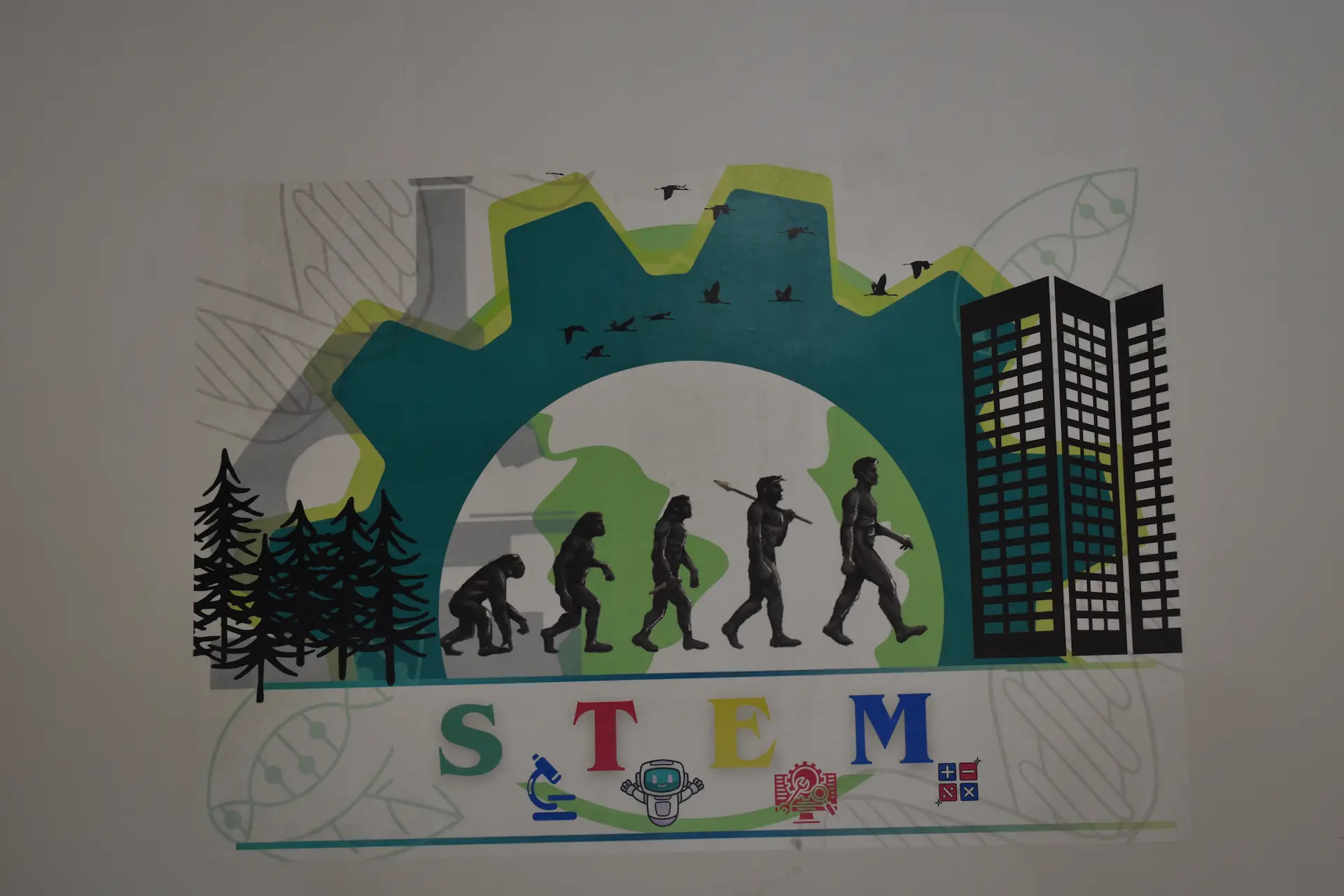
According to him, the project is aimed at helping students become more creative, motivating them to create innovations, implement and use new digital technologies, and adapt to the changing requirements of the future workplace and social environment. In line with the specifics of the National Commercial High School and its focus on economic disciplines, the STEM environment has been built in three main directions – natural sciences, green technologies and sustainable development, as well as mathematics and informatics.
In his address, the principal also stressed that individual subjects should not exist in isolation, but should be viewed in their interconnection, just as they function in the real world. That is why, in the new STEM organization of the school environment, disciplines such as physics and astronomy, biology and health education, chemistry and environmental protection, geography and economics, economic informatics, and entrepreneurship all find their place.
Within the project, several key educational spaces have been created at NTG. On the first floor, under the direction “Natural Sciences”, a “Center for Natural Sciences, Research and Innovation” has been established, represented by three classrooms – laboratories in physics, biology, and chemistry. There, students will be able to apply the theoretical knowledge they have learned, work on real problems, and build practical skills through a research-based approach. On the same floor there is also a Maker Space workshop under the direction “Mathematics and Informatics”.
On the second floor, a “Classroom for Creative Digital Creators” has been set up, equipped according to the standards of the “Mathematics and Informatics” direction, where students will be able to work on video content, computer and video games, digital tools, platforms, and mobile applications. A classroom in geography, economics, and sustainable development has also been created, intended for project-based learning, VR simulations, green entrepreneurship, and work with geographic information systems.
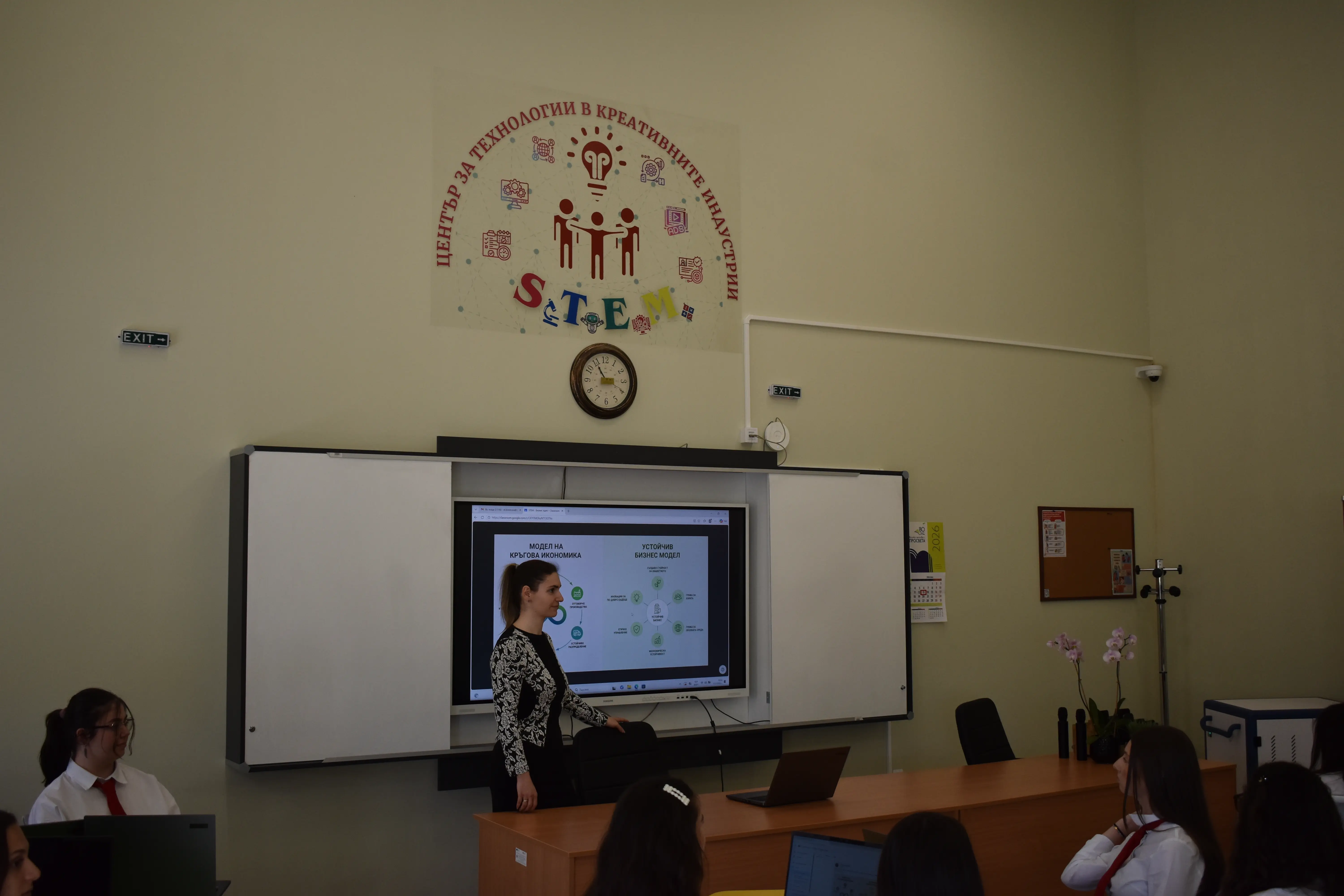
On the third floor, a “Center for Technologies in the Creative Industries” has been built – a STEM entrepreneurship classroom with a designated area for creative digital creators. The space is intended for students in the specialties “Economic Informatics”, “E-commerce”, and for the activities of training firms.
A substantial part of the project is also the technological support of the new environment. Interactive displays, laptops, STEM data loggers with built-in sensors, 3D virtual reality glasses, OPS modules, and specialized software have been provided. In this way, modernization does not remain only at the level of interior design, but becomes a real functional educational environment.
Special attention has been paid to the STEM chemistry and biology classrooms, which have been built as spaces for innovation, experiments, and discoveries. With the help of a digital camera and an interactive display, every experiment can be transmitted in real time in high resolution, so that in the new learning environment there are no “back-row desks” for science. The interiors of the classrooms have been designed in such a way as to provoke curiosity and interest in the natural sciences.
The school team, led by the project coordinator and geography and economics teacher Yuliya Kyoseva and the biology teachers Zhulieta Gocheva and Mariela Kehayova, the chemistry teacher Nevena Samohodova, the cybersecurity teacher Delyana Nikolova, the entrepreneurship teacher Sofia Dimitrova, and chief teacher Yordanka Arabadzhieva, demonstrated the power of modern education through a unique 5-stage transdisciplinary STEM lesson of the “Business Navigator” type in innovative technologies.
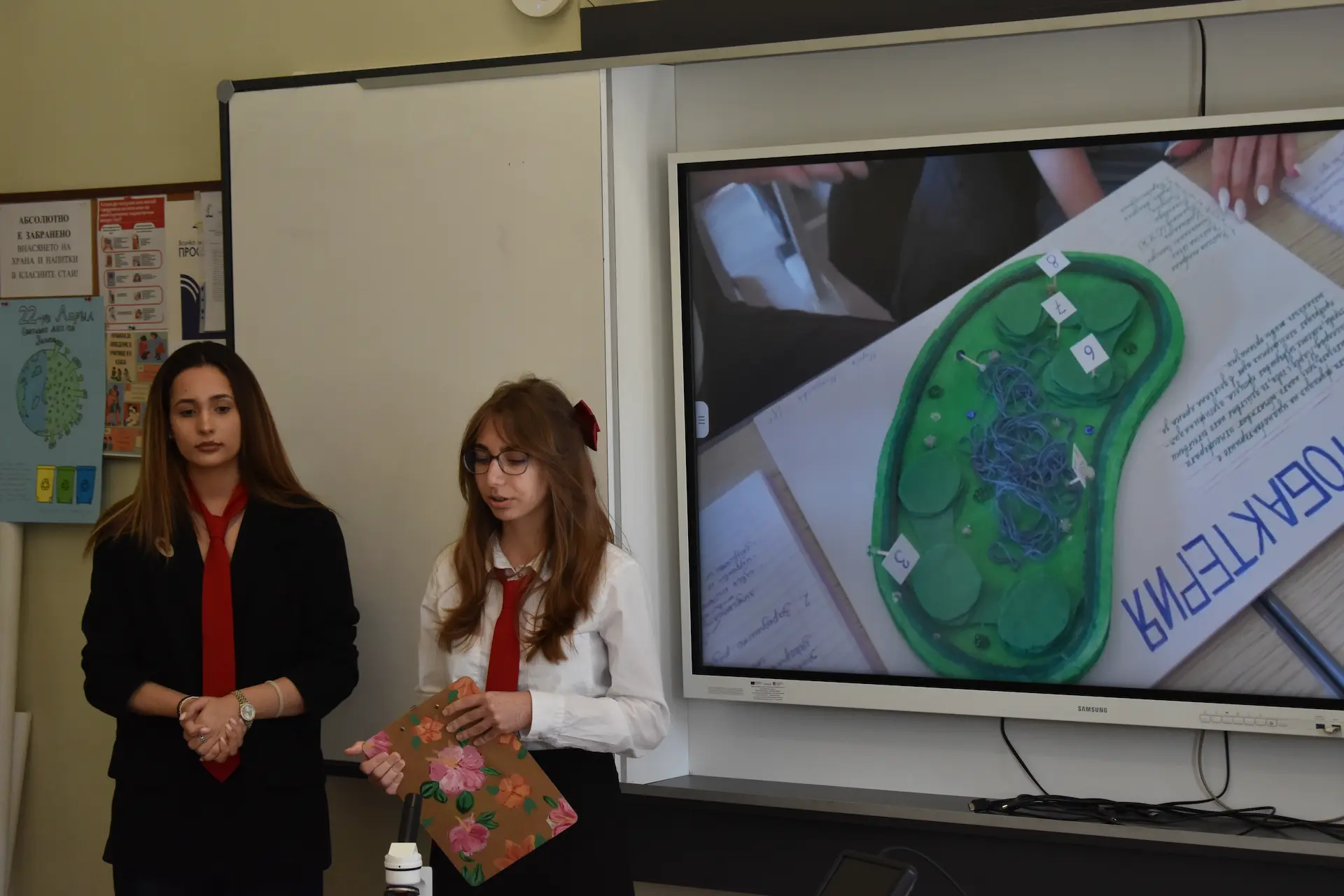
Designed through UbD design, the lesson made possible the transfer of knowledge between completely different school disciplines, focusing on the students’ practical-applied skills and the creation of a synergistic business product – an innovative business idea. At the core of the STEM concept was the fundamental model of the four “C’s” – critical thinking, creativity, communication, and collaboration. During the presentations, the students proved that they are able not simply to memorize facts, but to analyze, cooperate, think outside the box, and present their results digitally.
A journey in five stages: when science turns into business
Part of the lessons was presented to the audience through dynamic video highlights from the different classrooms of the STEM center.
Stage 1: Hunters of evolutionary technologies
The journey began outside the classroom – in the Natural History Museum, turned into a natural environment for observation. Through the method of gamification, the students were challenged to become “hunters” of the first photosynthesizing organisms on Earth – the ancient cyanobacteria responsible for creating oxygen in the atmosphere. Each team had the task of taking live samples and transporting them to the school for the next scientific phase.
Stage 2: From empirical to scientific knowledge
In the school biology laboratory, 10th-grade students from the “Business Administration” specialty used a high-tech electronic microscope to move from the macro to the micro level. They studied the cellular structure and the unique photosynthetic capabilities of blue-green algae, turning scientific inspiration into concrete biological data.
Stage 3: Proving the hypothesis
In the STEM chemistry classroom, the students conducted a chemical experiment to monitor pH levels and the effect of light on the photosynthesis of cyanobacteria. Using real data processed in Excel, they proved that under intense lighting these organisms actively absorb carbon dioxide in closed spaces. Thus, the first large-scale business idea was born – creating innovative bio-air purifiers for classrooms.
Cybersecurity in biotechnology
Ninth-grade students from the “Economic Informatics” specialty presented a problem-based lesson in the innovative subject “Cybersecurity”. They raised the critical question of protecting scientific research and intellectual property from manipulation in real business.
Stage 4: Market analysis and GIS technologies
In the geography classroom, 10th-grade students from the “Economic Informatics” specialty presented a SWOT analysis of the biotechnology sector in Bulgaria. Through Google My Maps, they created an interactive map of research centers in the country, analyzed the market niche, and outlined Bulgaria’s potential to become a regional leader in the green economy through the implementation of innovative ecological technologies.
The final touch: creative industries and artificial intelligence
The culmination of the official opening took place in the “Center for Creative Industries” – the STEM entrepreneurship classroom. There, the model “peers teach peers” was applied. Eighth-graders studying applied economics worked together with mentors from the 11th grade, who already have rich experience in national competitions for business ideas and scientific conferences. After analyzing circular economy models, the older students helped the younger ones shape and visualize their innovative business ideas with the help of artificial intelligence. The final projects were shared in real time through Google Classroom with all the guests at the event.
“This project proves how educational content can step out of the textbook framework and be applied practically in real life. We connected science, technology, and sustainable development with entrepreneurship in order to prepare students for the real challenges of the knowledge economy,” the school leadership also shared.
At the end of the opening, principal Nikolay Mitev emphasized that the meaning of the new STEM environment is not limited to modern equipment and new classrooms. “It is aimed at building connections – between the sciences, between theory and practice, and last but not least – between education, the economy, and real business,” he also pointed out in his speech.
Official guests at the event included the secretary of the “Centralen” district Emil Saraliyski, the chief expert “Education, Sports and Youth Activities” at the “Centralen” district Dimitrinka Ilieva, the senior expert in natural sciences and ecology at the Regional Department of Education – Plovdiv Tatyana Tsankova, the director of the Regional Natural History Museum Ognyan Todorov and his team, the chairman of the Public Council of NTG Rangel Matanski, representatives of the Regional STEM Center in Hisarya, as well as a number of partners, guests, and friends of the National Commercial High School.
The new STEM center of the National Commercial High School makes a strong claim to be an incubator for future leaders, scientists, and entrepreneurs who will build a cleaner, more responsible, safer, and technologically developed society.