They were created by specialists from the Regional Natural History Museum – Plovdiv and are based in the biology classroom and the geography and economics classroom, where they will support teaching through real mineral and rock specimens. The exhibition in the “Geography, Economics and Sustainable Development” classroom presents authentic specimens that tell the story of Bulgaria’s geological history and natural wealth. Through them, students can trace the development of rocks from the Precambrian to the Cenozoic and also understand their chemical composition, physical properties, and applications in various fields.
A thematic exhibition has also been set up in the biology classroom, complementing biology and health education. Through visual specimens and scientific information, students have the opportunity to better understand the links between natural processes, ecology, and environmental protection.
“Modern education should give students the opportunity not only to acquire knowledge, but also to explore and discover the links between science and the real world,” emphasized Nikolay Milev, Principal of the National Commercial High School, at the opening of the exhibitions. According to him, such initiatives encourage young people’s curiosity and show how what is learned in class has practical application.
Chief Assistant Professor Dr. Ognyan Todorov, Director of the Regional Natural History Museum – Plovdiv, noted that the cooperation between the museum and the high school is an important step toward closer contact between science and students. He expressed confidence that the partnership can continue to develop in the future through educational lectures and meetings with students that will expand their knowledge of nature and its resources.
The project shows how different scientific fields can be connected in one integrated learning process. Students work with knowledge from geography, chemistry, physics, and ecology to analyze minerals and their role in modern technologies—from water purification through zeolite, to emission desulfurization with limestone, to the application of serpentinite in nuclear energy and bentonite in infrastructure construction.
An innovative element in the learning process is also the use of geographic information systems (GIS) and artificial intelligence tools, through which students can locate mineral deposits and analyze their application in the context of the modern “green economy”.
The activities are implemented within project BG-RRP-1.015-0928-C01 “Building a School STEM Environment at the National Commercial High School – Plovdiv”, financed under procedure BG-RRP-1.015 “School STEM Environment” from the National Recovery and Resilience Plan of the Republic of Bulgaria with funds from the European Union. The project includes the delivery, installation, and commissioning of equipment for the construction of a STEM center and high-tech equipped and connected classrooms, which create conditions for more practical and research-based learning.
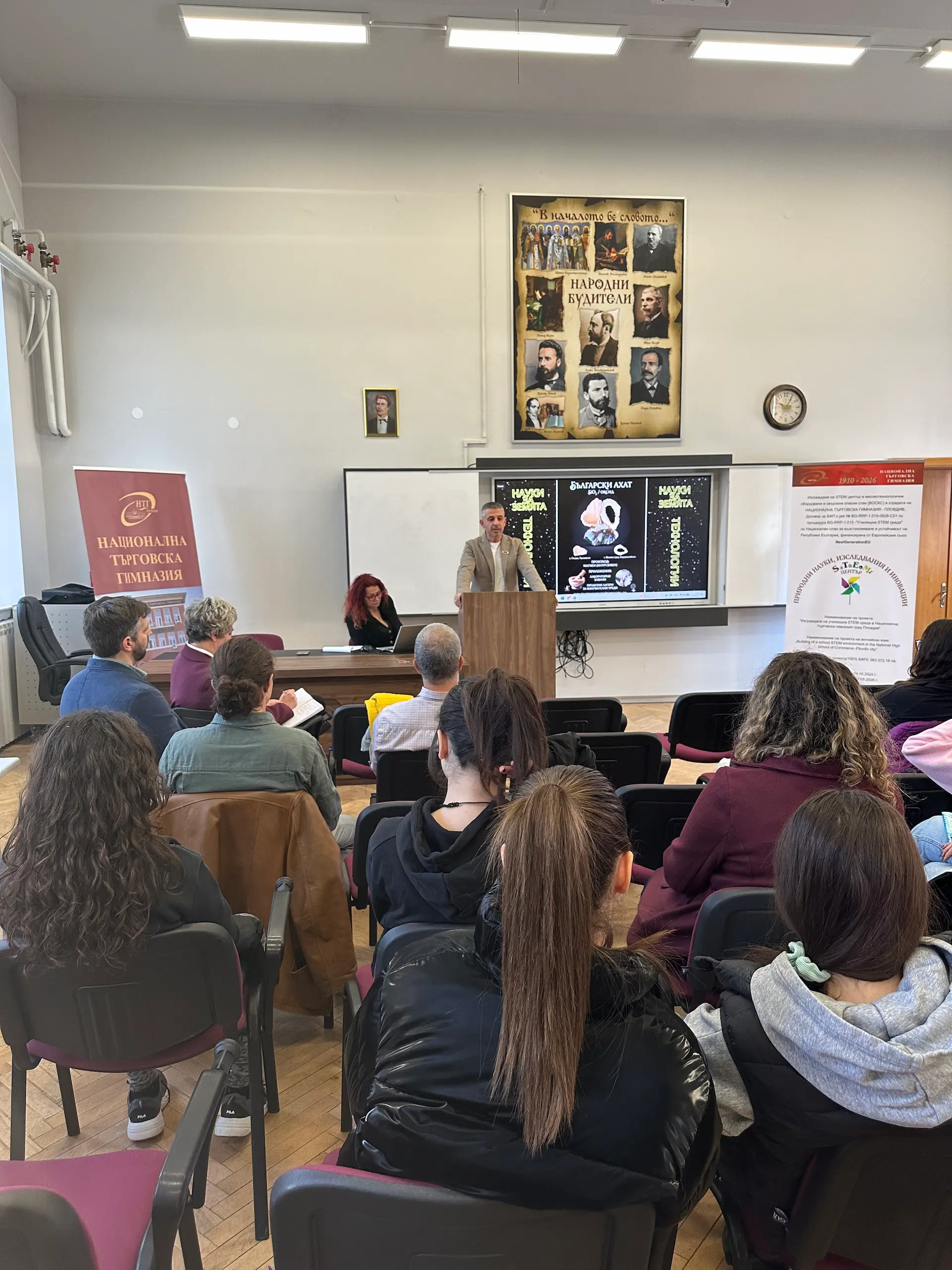
During the event, presentations were given about the initiative and about the museum’s activities. Senior teacher of geography and economics Yulia Kyoseva explained how the new exhibitions will be used in the learning process and how, through them, students can explore the origin and application of minerals.
After the official part, the guests and the students examined the exhibitions up close and became acquainted with the displayed specimens. The initiative was implemented thanks to the work of senior teachers Yulia Kyoseva and Nevena Samohodova, who actively introduce project-based learning in their teaching disciplines.